History of döner
From Ottoman fires to Berlin nights: the true history of döner kebab
Döner was neither conjured out of nowhere in Berlin in 1972 nor born as a fixed recipe one morning in Bursa. It is an Ottoman technique that became an urban dish, a migrant sandwich, a European industry and a popular icon. From seventeenth-century miniatures to Swiss counters, this is what the evidence supports—and what remains legend.
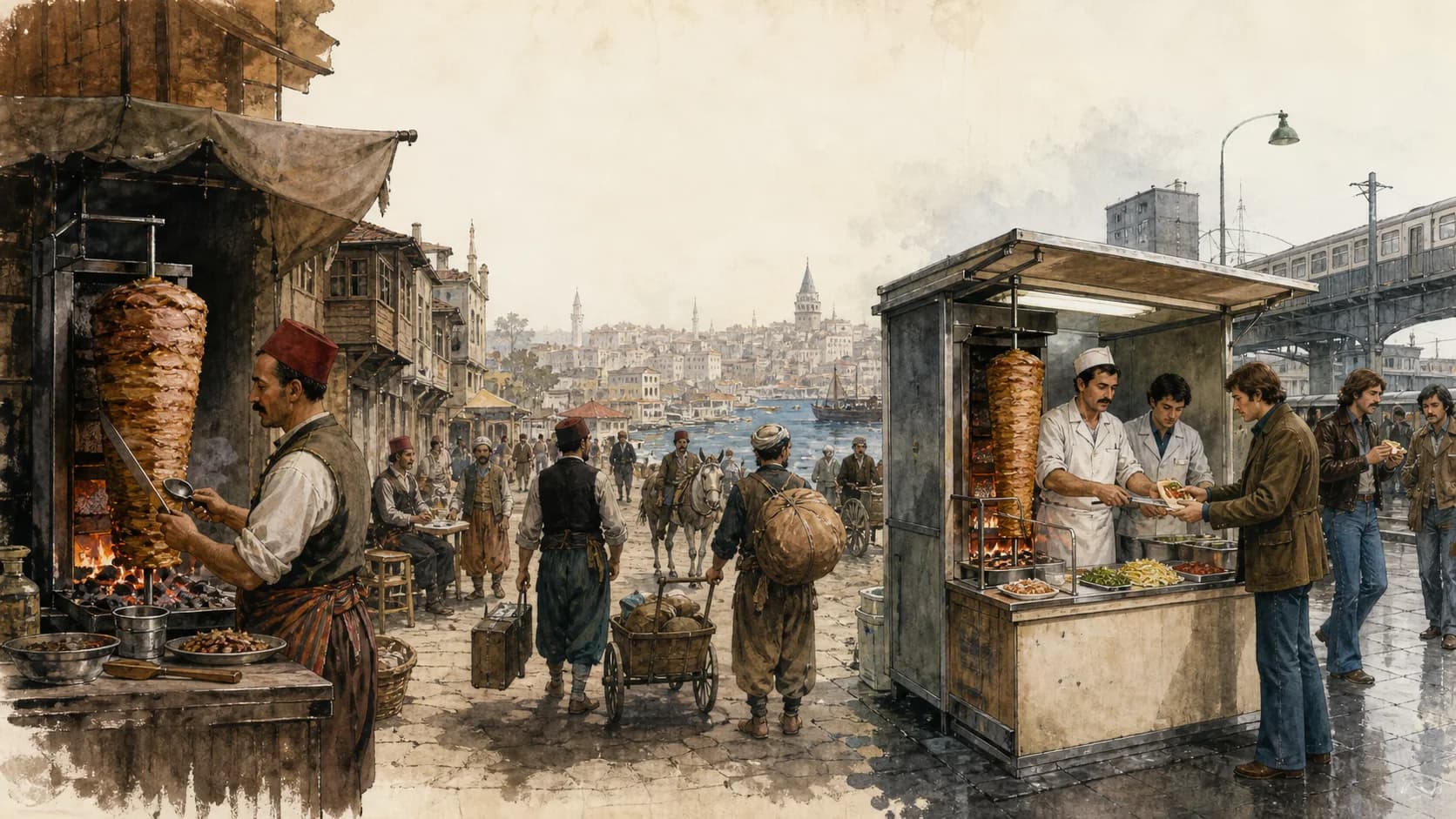
Before döner, there was kebab
Kebab originally describes a broad family of roasted or grilled preparations, not a sandwich filled with meat, salad and white sauce. In modern Türkiye it includes şiş kebap, minced Adana kebap, horizontal cağ kebabı and vertical döner kebap.
A popular story depicts Ottoman soldiers roasting meat on their swords. The scene is plausible as battlefield improvisation, but no known contemporary Ottoman source makes it the birth of kebab. Kabāb was already described in Ibn Sayyār al-Warrāq’s tenth-century Baghdad cookbook, centuries before the Ottoman Empire. The swords belong to legend, not demonstrated history.
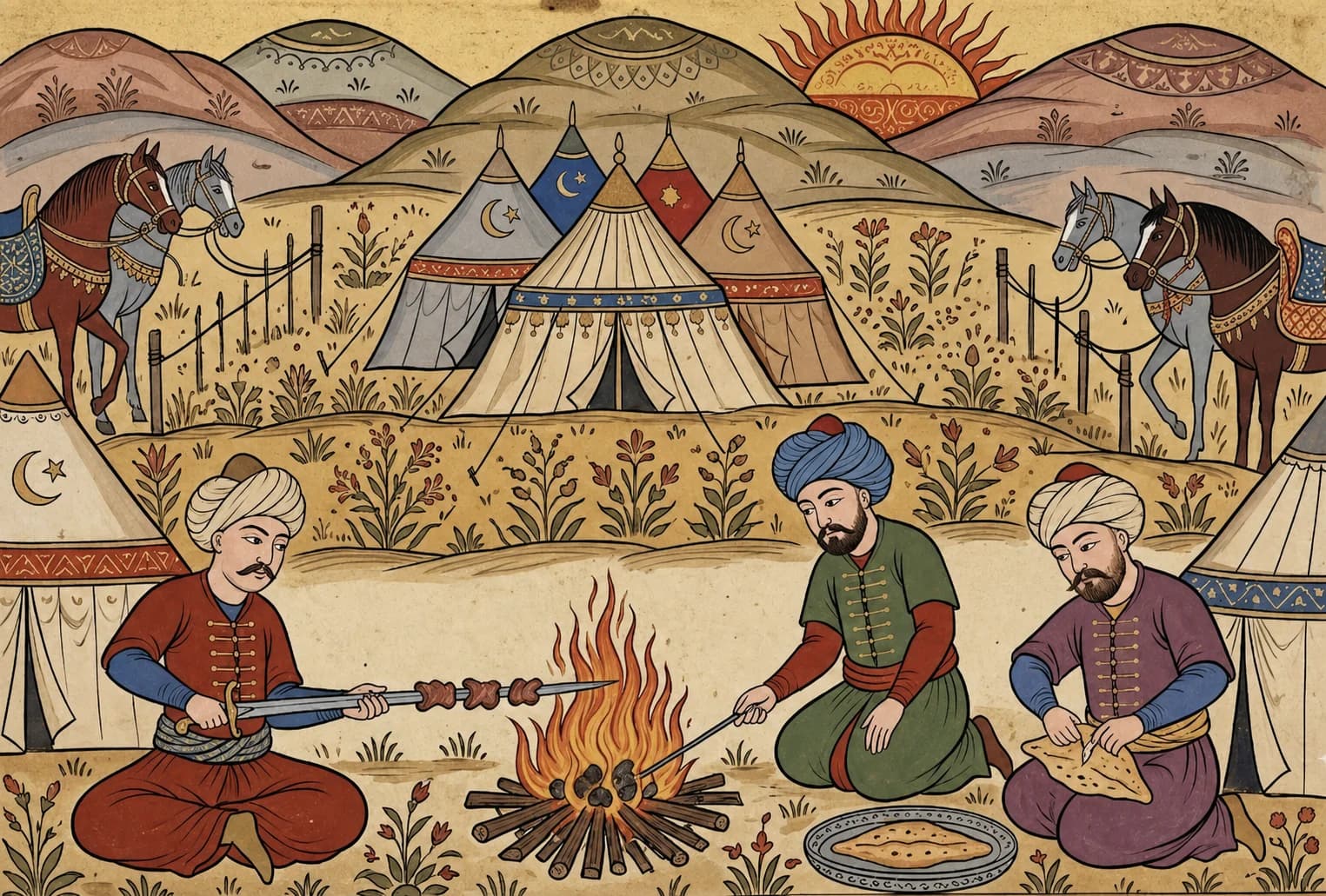
Döner comes from the Turkish verb dönmek, ‘to turn’. Döner kebap is therefore the ‘turning kebab’: a name for a technique rather than a fixed list of ingredients.
This distinction matters. Kebab as a culinary family was not invented in Berlin, but the döner eaten on European streets was substantially shaped in Germany.
The Ottoman foundation: first a horizontal spit
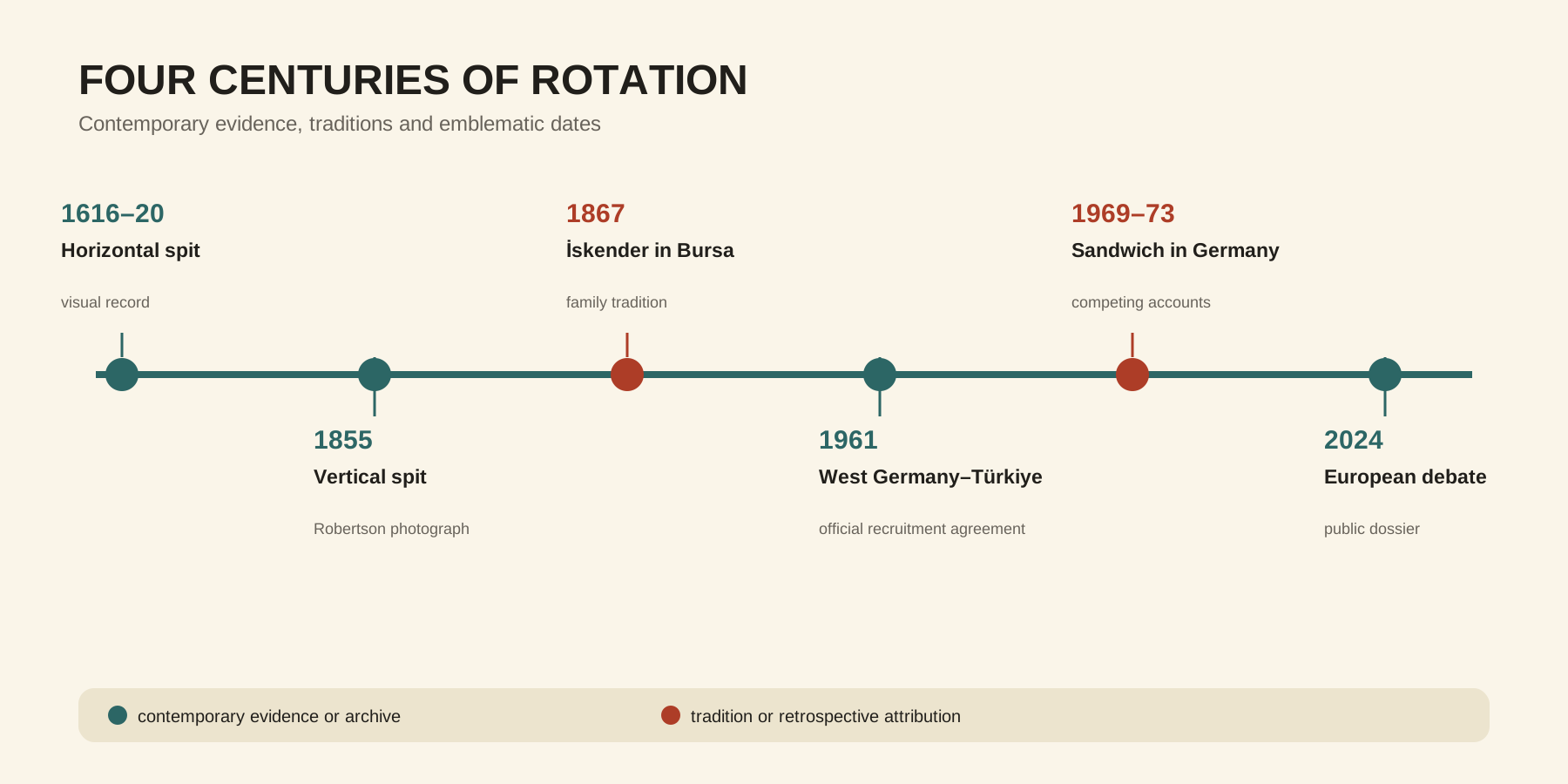
The history of döner begins less with one inventor than with a change of orientation. Food historian Priscilla Mary Işın identifies two Istanbul miniatures dated 1616–1620 that show outdoor cooking on a horizontal spit, resembling cağ kebabı.
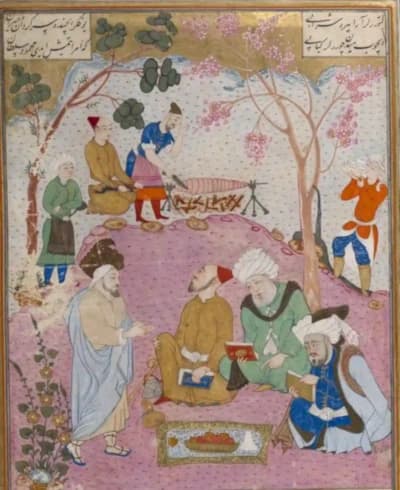
Turning the spit upright changes the dish’s physics. Rendered fat runs down and bastes the stack, while the cook shaves the browned exterior and leaves the centre to continue cooking. The apparatus also occupies less floor space in an urban shop.
The strongest visual evidence is James Robertson’s 1855 photograph. Beside a meat seller stands a recognisable stack near a vertical heat source. It supplies neither a recipe nor an inventor, but proves that vertical cooking existed in Constantinople by 1855.
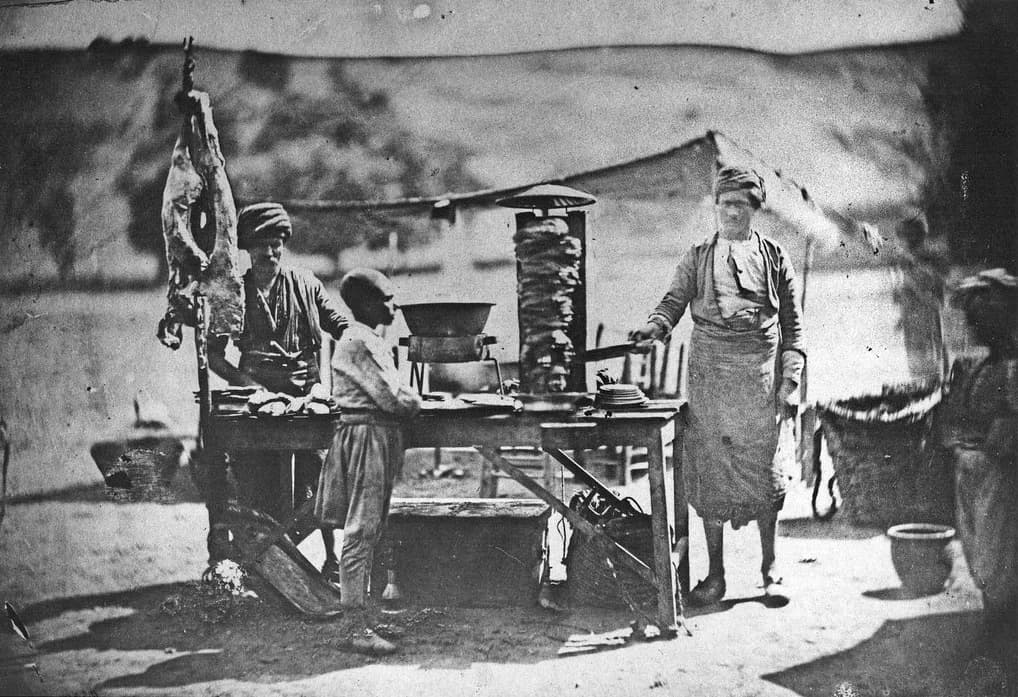
According to Işın, the written expression döner kebap is documented only in 1908. The practice can predate the printed name: popular food leaves fewer archives than official history.
Bursa, 1867: birthplace, capital or brilliant family history?
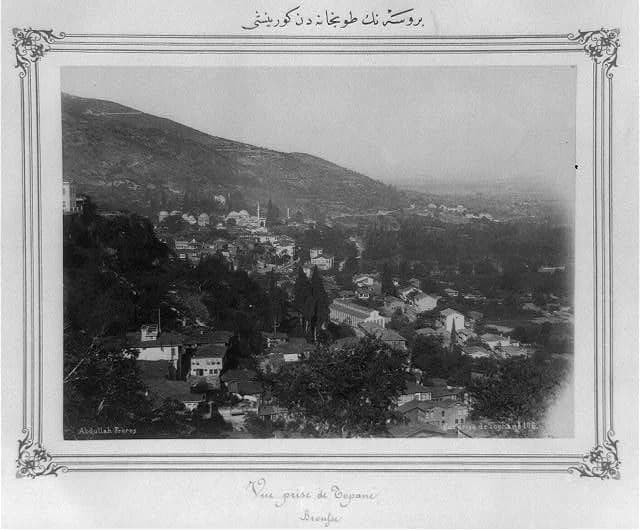
Bursa is often called the birthplace of döner. The former Ottoman capital was a major commercial crossroads with sheep farming, food artisans and, above all, a dynasty that became inseparable from the dish.
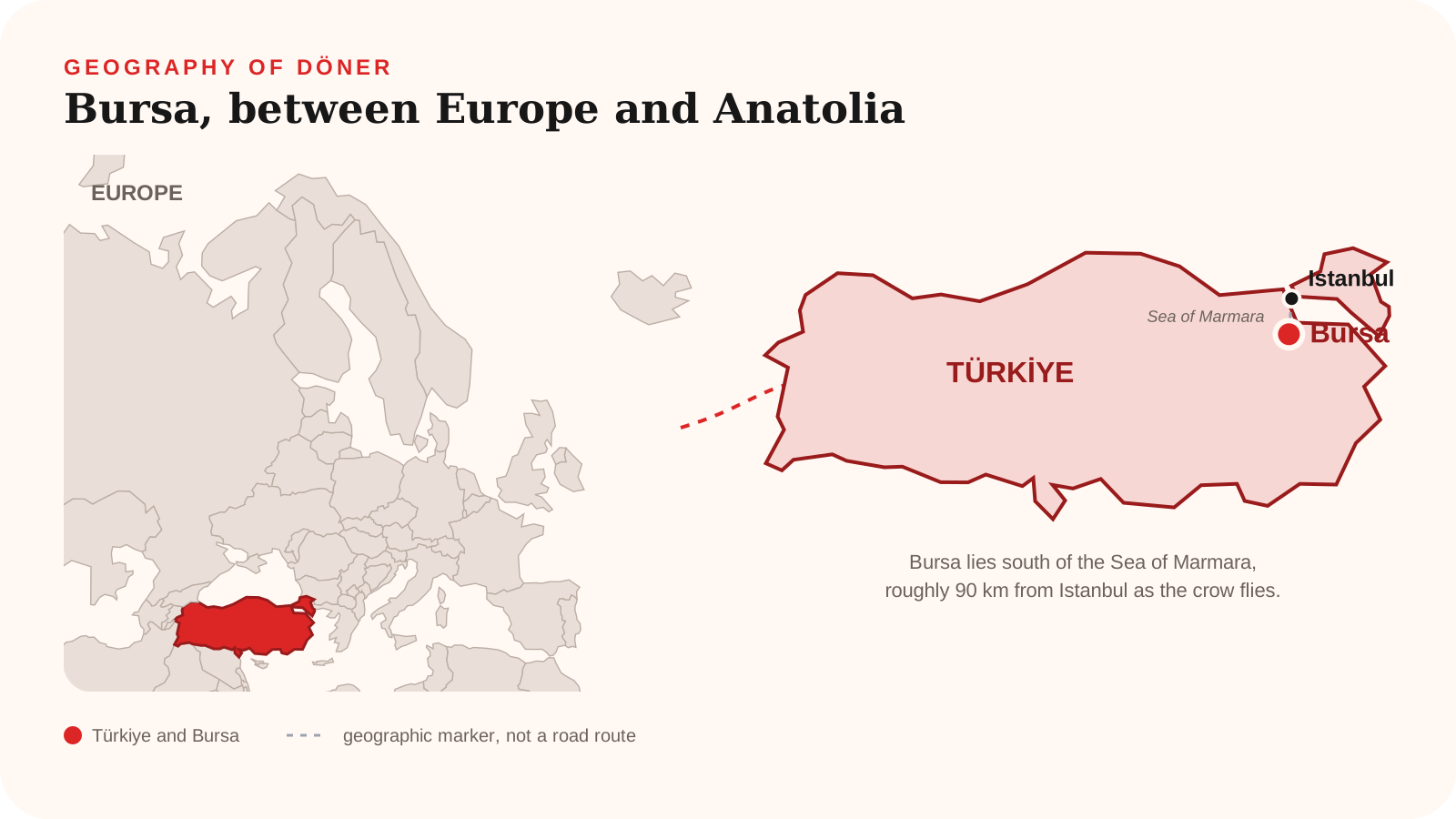
According to the İskenderoğlu family tradition, Mehmet oğlu İskender Efendi transformed the cooking of mutton at Kayhan market in 1867: boning it, layering lean and fatty cuts vertically before charcoal, then serving thin slices over bread with butter, tomato and yoghurt.
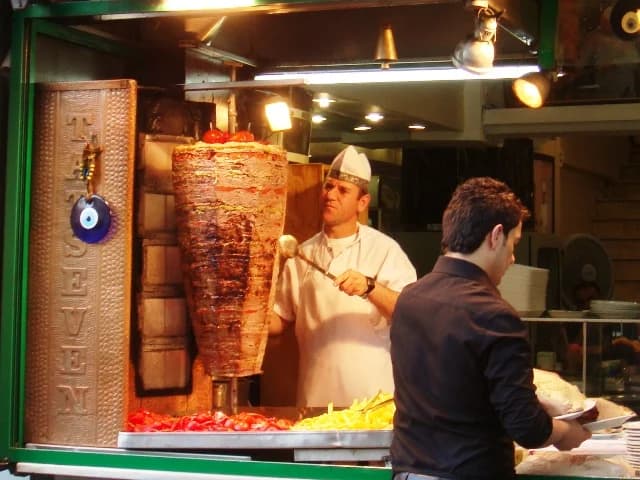
The method is coherent: layering different cuts gives every customer a more consistent balance of meat and fat. Served over bread with tomato sauce, yoghurt and melted butter, it became İskender kebap, also known as Bursa kebabı.
Yet the date rests mainly on the family’s memory and archives, while Robertson’s 1855 image already shows vertical cooking. The safest conclusion is that İskender Efendi did not single-handedly invent the vertical spit, but his house helped codify and make a major Bursa style famous.
Hamdi Usta: the contender from Kastamonu
A competing tradition attributes the vertical spit to Hamdi Usta, a cook from Kastamonu, as early as the 1830s, sometimes adding that his sons continued the trade in Istanbul.
The documentary problem is decisive. Available accounts are late and often repeat one another; there is no known patent, dated menu or contemporary article that settles the claim. It remains a plausible competing tradition, not an established fact.
The Bursa–Kastamonu rivalry reflects a modern desire for an ‘Edison of döner’. Food techniques more often emerge through successive improvements by butchers, cooks and restaurateurs.
From Bursa to Istanbul: döner becomes urban
Around 1900, döner entered written vocabulary and spread through cities. In Istanbul, restaurants turned cooking into street theatre: the spit was visible, slicing to order signalled freshness, and the smell of fat and charcoal acted as advertising.
A print held by Royal Museums Greenwich captures that transition. Dated around 1920, it shows two Turkish men in a doorway beside a tall vertical meat stack, a tray for trimmings and firewood below. The museum names neither the shop nor the men, so it documents an organised trade rather than an individual origin.
The Turkish dish remained plural: served with rice or bread, rolled in dürüm, put into a loaf, or transformed into İskender. Its continuity lies not in one immutable recipe but in a grammar of layered meat, vertical rotation, surface cooking and progressive slicing.
1961: the history of döner meets migration
On 30 October 1961, West Germany and Türkiye signed a recruitment agreement in Bonn. West Germany needed labour; Türkiye saw temporary migration as a source of skills and foreign currency. The workers were called Gastarbeiter, ‘guest workers’.
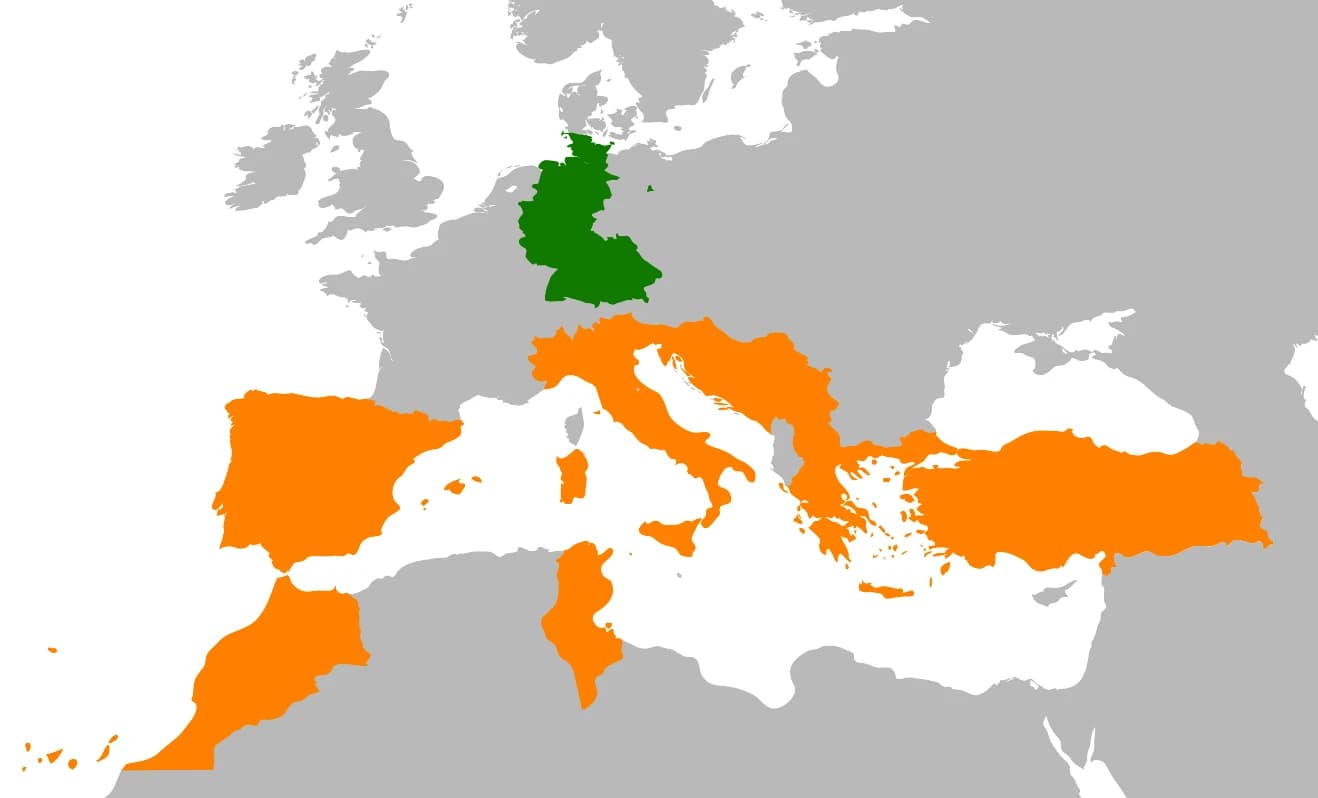
The supposedly temporary arrangement became durable. The original two-year limit ended in 1964, stays lengthened, families reunited and commercial networks formed. Recruitment stopped in 1973, but Turkish life was already a lasting part of West German society.
Restaurants offered independence to migrants facing hard industrial work, discrimination and deskilling. Döner became one of the everyday places where Turkish belonging and participation in the wider city met.
Berlin, 1972: Kadir Nurman and the myth of the first sandwich
The best-known account is a perfect scene. In 1972, Turkish worker Kadir Nurman opened a counter opposite Zoologischer Garten station in West Berlin. Seeing Berliners eat while walking, he put döner meat into bread with onions or salad—and supposedly created the sandwich.
Nurman was real. He arrived in Germany in the early 1960s, later sold döner near Bahnhof Zoo and was honoured by a Turkish döner trade association in 2011. Many obituaries in 2013 called him the inventor of döner kebab.
The definite article goes too far. Other restaurateurs claimed earlier or contemporary versions: Nevzat Salim in Reutlingen in 1969, İbrahim Keyif in Berlin that year, and Hasir founder Mehmet Aygün in Kreuzberg in 1971.
What is well documented is Berlin’s popularisation of a recognisable combination: generous bread, meat cut to order, abundant vegetables, sauces and eating while standing or walking. Nurman deserves a central but accurate place—as pioneer and symbol, not undisputed owner of an imaginary culinary patent.
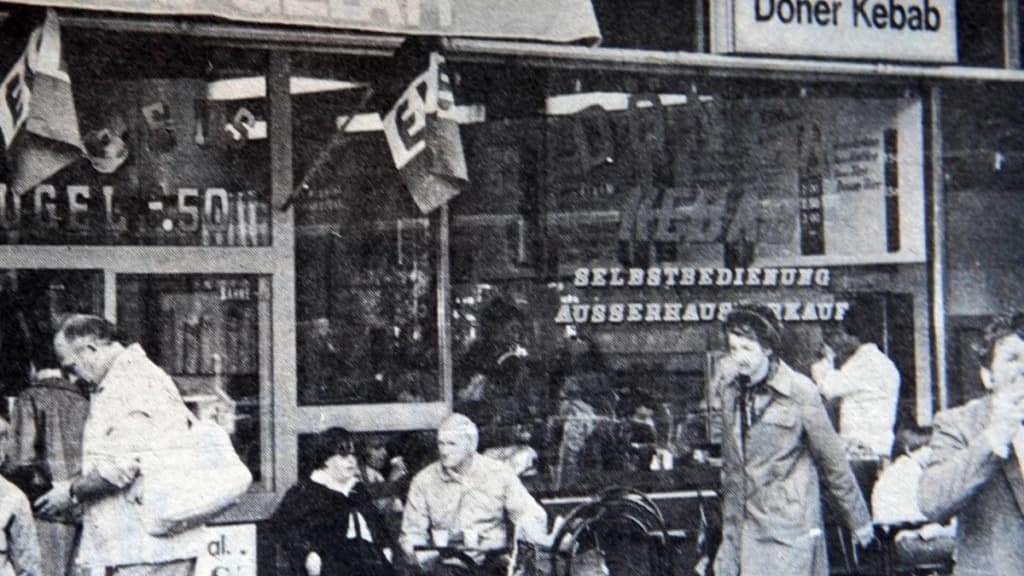
No publicly accessible photograph securely dated to his 1972 counter was found. B.Z. nevertheless holds the authorised shop view reproduced below, a 1980s picture of Nurman behind his spit and an old advertisement. They confirm place and activity, but not the ‘first photograph of Berlin döner’.
What Berlin changed
Berlin döner did more than wrap a Turkish dish. It responded to another city, another public and another economy.
- Portability: bread became a complete container suited to stations, factories and eating without crockery.
- Contrast: cabbage, lettuce, tomato, cucumber and onion added crunch, freshness and volume.
- Sauces: garlic, herbs, chilli and yoghurt adapted to local habits and differentiated shops.
- Production: demand created spit manufacturers, cold chains and standardised recipes.
- Identity: döner became Berliner and German while remaining tied to Turkish history—a double lineage about citizenship as much as food.
A European conquest without a master plan
From Germany, the format spread through mobility, suppliers and professional learning to Austria, Switzerland, Benelux, Scandinavia, France and Britain. Each country translated the model.
In France, kebab often means the sandwich itself. British late-night doner coexists with shish and Cypriot traditions. In Germany, Döner alone is enough, while Berlin developed Gemüsedöner with grilled vegetables.
This was not a straight line from one kiosk but a network of restaurateurs, families, former factory workers, equipment makers, wholesalers, bakers, customers and nocturnal cities. European döner is migration infrastructure as much as a recipe.
And Switzerland? A discreet history at a crossroads
Switzerland has no founding story as famous as Berlin’s. One early local marker is documented: Zurich’s official gastronomy timeline dates the city’s first ‘Kebab-Stand’, called ‘1001’, to 1973. This does not prove it was Switzerland’s first, but it provides a remarkably early verifiable point.
Döner then grew with post-war migration from Türkiye and later Balkan and Middle Eastern movements. Available archives still document migration better than the first shops, a limitation that should not be filled with invented dates.
Communities originating in Türkiye became noticeable from the 1960s and 1970s. In 2022 federal statistics counted 69,182 Turkish nationals in the permanent foreign resident population, excluding many naturalised Swiss people of Turkish origin.
Swiss-German döner looks towards Germany and Austria; French-speaking Switzerland often uses the shorthand kebab and shares codes with France. Levantine shawarma and Balkan traditions also overlap.
As in Germany, the counter became a space of daily contact. The symbol should not hide the labour behind it: long hours, narrow margins, linguistic adaptation and family transmission.
Döner, shawarma, gyros and al pastor: cousins, not copies
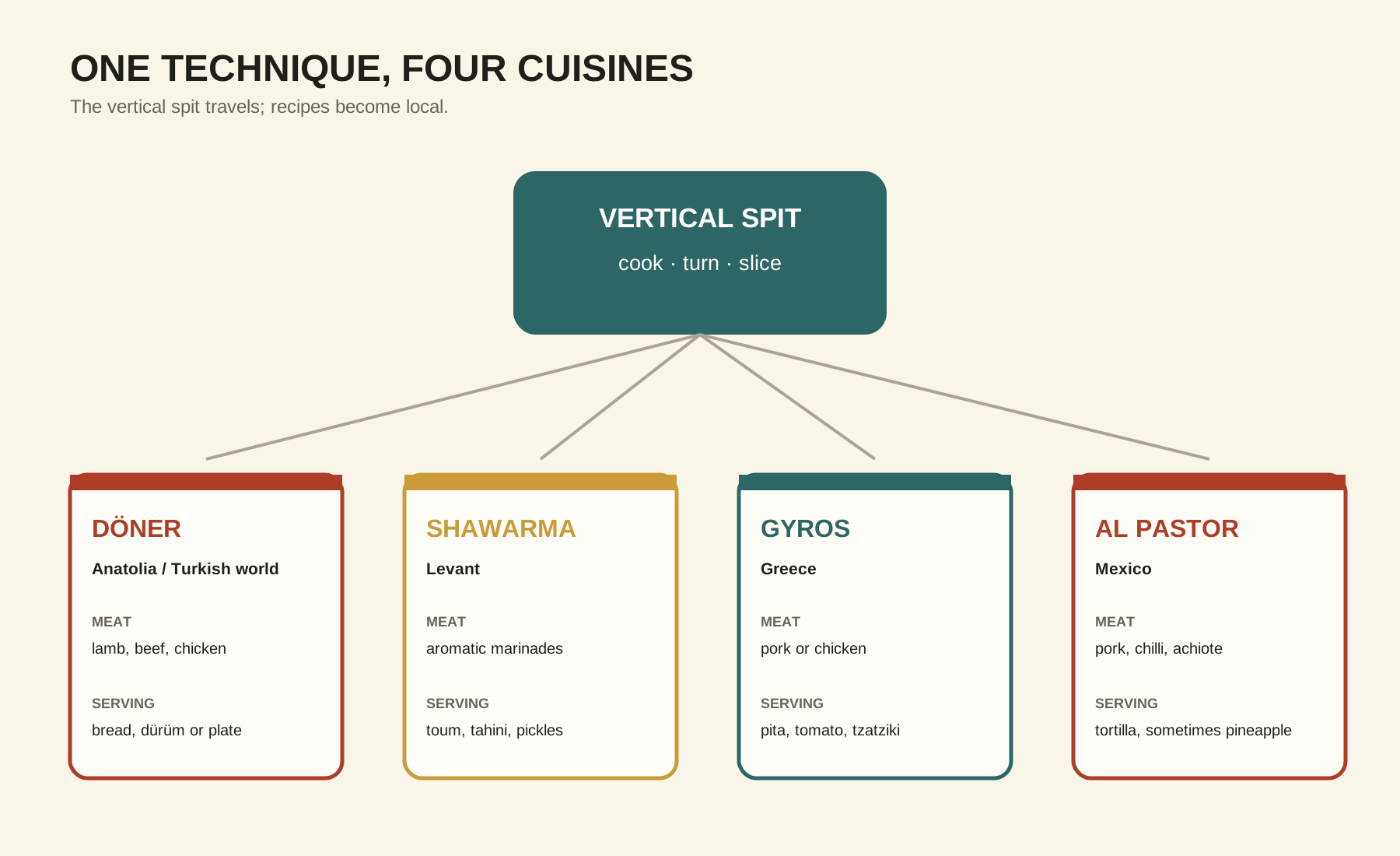
All four share a technology—a vertical stack cooked and sliced at the surface—but each is rooted in a distinct local history.
Ottoman döner traditionally used lamb or mutton, later beef, veal and chicken. Türkiye serves it on a plate, in dürüm or bread; the European Berlin style emphasises vegetables and sauces.
Shawarma is an autonomous Levantine branch with aromatic marinades, tahini, toum and pickles. Greek gyros today commonly uses pork or chicken with pita, tomato, onion and tzatziki.
Lebanese migration brought spit-roasted meat to Mexico, where pork, chillies, achiote, corn tortillas and sometimes pineapple produced al pastor: a Mexican creation from a migrant Levantine technique related to Ottoman döner.
Myths and verdicts
Plausible legend, unproven
« Ottoman soldiers invented kebab by grilling meat on their swords. »
No contemporary Ottoman military source confirms it; kabāb is documented in tenth-century Baghdad.
Misleading
« Döner was invented in Berlin. »
The vertical technique is Ottoman and documented in the nineteenth century. Berlin shaped the modern sandwich.
Unproven
« İskender Efendi invented the vertical spit in 1867. »
His Bursa legacy is major, but an 1855 photograph already shows a vertical installation.
Unlikely
« Kadir Nurman alone invented döner in bread. »
He is the best-known pioneer; several competitors claim similar or earlier dates.
False
« Shawarma, gyros and al pastor are the same dish. »
They share connected technology but differ in meats, marinades, breads and histories.
False dilemma
« Döner is either Turkish or German. »
The spit belongs to Ottoman and Turkish history; the Berlin sandwich is Turkish-German.
Conclusion: a history in motion
Döner is aptly named. It turns on its spit and from city to city, language to language and class to class. Each turn reveals another layer: Ottoman picnic, Bursa shop, Istanbul street, West German factory, Berlin kiosk and Swiss station exit.
Searching for one inventor shrinks that history. Döner’s real genius is collective: cooks reoriented the spit, families stabilised recipes, migrants turned a dish into a business, and cities added breads, sauces and rhythms. It is living food made by movement.
References and method
Contemporary sources and historians’ research take priority. Family accounts are retained for their cultural importance but identified as such. A frequently repeated date is not automatically a proven date.
- Priscilla Mary Işın — Bountiful Empire: A History of Ottoman Cuisine
- Ibn Sayyār al-Warrāq — Annals of the Caliphs’ Kitchens, traduction de Nawal Nasrallah, Brill
- National Geographic — The story behind the doner kebab
- James Robertson — Marchands de viande (döner kebab), 1855, SALT Research
- Wikimedia Commons — copie signalée PD-Ottoman de la photographie de 1855
- Servet Kazım Güney — Foods spreading from Turkish cuisine to the world, Journal of Multidisciplinary Academic Tourism, 2023
- Istanbul Notes — reproduction de la miniature ottomane à broche horizontale, vers 1616–1620
- Royal Museums Greenwich — Two Turkish men with a doner kebab, vers 1920, ALB1513.356
- Library of Congress — vue de Bursa par les frères Abdullah, 1880–1893
- Natural Earth — contours géographiques de la carte Europe–Turquie–Bursa, domaine public
- Wikimedia Commons — comptoir de döner à Istanbul, Shoestring, 2012, CC BY-SA 4.0
- Wikimedia Commons — carte des accords de recrutement de la RFA, domaine public
- Stadsarchief Amsterdam — complexe Atatürk pour travailleurs turcs, 1965, CC0
- Direction de la culture et du tourisme de Bursa — Bursa Kebab
- Kebapçı İskender — histoire de la maison
- Bundeszentrale für politische Bildung — accord de recrutement RFA–Turquie
- Ministère fédéral allemand des Affaires étrangères — l’accord de 1961
- Der Tagesspiegel — Döner-Erfinder Kadir Nurman ist tot
- B.Z. — galerie Kadir Nurman, son échoppe des années 1980 et une publicité d’époque
- Deutsche Digitale Bibliothek — Bahnhof Zoo vu depuis la Hardenbergstraße, Willy Pragher, 1970
- Oxford Companion to Food — Doner Kebab
- Rudolph & Hillmann — How Turkish is the doner kebab?
- Secrétariat d’État aux migrations — statistiques 2022
- Ville de Zurich — chronologie de la gastronomie : ouverture du Kebab-Stand « 1001 » en 1973
- SRF — Integration durch Essen
- Associated Press — Turkey wants to regulate Germany’s beloved döner